This is a good handbook for North Carolina Bicycle Shops and riders to have.
http://www.ncdot.gov/bikeped/download/bikeped_laws_Guidebook-Part-2.pdf
The U.S. Consumer Product Safety Commission, in cooperation with the firm named below, today announced a voluntary recall of the following consumer product. Consumers should stop using recalled products immediately unless otherwise instructed. It is illegal to resell or attempt to resell a recalled consumer product.
(Logo: http://photos.prnewswire.com/prnh/20030904/USCSCLOGO)
Name of product: Bicycles
Units: About 12,000
Distributor: Specialized Bicycle Components Inc., of Morgan Hill, Calif.
Manufacturer: Kinesis, of China
Hazard: The front fork can break, posing fall and injury hazards to riders.
Incidents/Injuries: Specialized has received four reports of front forks breaking, resulting in facial fractures, head and shoulder injuries and cuts.
Description: This recall involves some 2008 and 2009 models women's and men's Globe model bicycles. Recalled models include the Globe Elite, Globe Sport, Globe Sport Disc, Globe Centrum Comp, Globe Centrum Elite, Globe City 6, Globe Vienna 3, Globe Vienna 3 Disc, Globe Vienna 4, Globe Vienna Deluxe 3, Globe Vienna Deluxe 4, Globe Vienna Deluxe 5 and Globe Vienna Deluxe 6 bicycles. The bicycles were sold in various colors, including gun, silver, black, khaki, navy, bone, blue, charcoal, burgundy and gold. The brand name "Specialized" is on the lower frame tube and the model name is on various locations on the bicycle frame.
Sold at: Authorized Specialized retailers nationwide from July 2007 to July 2012 for between $550 and $1,100.
Manufactured in: China
Remedy: Consumers should immediately stop riding these bicycles and return them to an authorized Specialized retailer for the free installation of a free replacement fork.
Consumer Contact: For additional information, contact Specialized toll-free at (877) 808-8154 from 8 a.m. to 5 p.m. PT Monday through Friday, or visit the company's website at http://www.specialized.com and click on Support/Safety Notices.
Photos available at http://www.cpsc.gov/cpscpub/prerel/prhtml12/12281.html
The U.S. Consumer Product Safety Commission (CPSC) is still interested in receiving incident or injury reports that are either directly related to this product recall or involve a different hazard with the same product. Please tell us about your experience with the product on SaferProducts.gov.
PR Newswire (http://s.tt/1oikw)
Bike Accident Statistics. Biking Attorneys.
Submitted by kirksanderslaw on Fri, 02/25/2011 – 10:16am
bicycle accident lawyer Bicyclist deaths bike crash attorney biking injury car wreck attorney fatal crash attorney Kirk Sanders severe brain damage
The attorneys at Sanders Law Firm, PLLC have handled cases ranging from broken humerus requiring a permanent rod to quadraplegia with severe brain damage. If you have a biking accident, call us to discuss at 336-724-4707 or email kirk@kirksanderslaw.com. We'll evaluate your case at no cost to you. We represent bicyclists statewide in North Carolina (NC). If the event happened out of state, we will assist you in finding local counsel out-of-state.
Now here's some interesting statistics on bike accidents and helmet protection:
This comes from the Bicycle Helmet Safety Institute, which compiled the data from multiple sources. Don't let this deter you from riding. We need more riders and less car drivers.
Interestingly, it should be no surprise, based on a number of contributing factors, that you are far safer to WEAR A HELMET. I believe in helmets. One took the impact for me. I still had a concussion, but would hate to think what would have resulted without the helmet.
Remember: helmets are good for one impact, then they need to be disposed.
First, a summary of US statistics available from the National Highway Traffic Safety Administration: Traffic Safety Facts – 2009 Data (released in 2010, and still the most recent)
* 630 bicyclists died on US roads in 2009 (718 in 2008, 1,003 in 1975)
* 74 were 14 or younger, a reduction of 58 per cent from the 178 killed in 2000.
* Bicyclist deaths represented 2 per cent of all 2009 traffic fatalities.
* 51,000 bicyclists were injured in traffic in 2009 (Up sharply from 43,000 in 2007)
And some more statistics from 2008 data also released in 2010:
* One-seventh of the cyclists killed were between 5 and 15 years old.
* Average age of a bicyclist killed on US roads: 41
* Average age of a bicyclist injured on US roads: 31
* Bicyclists 15 and under killed: 93. Injured: 13,000
* Bicyclists 16 to 34 killed: 168. Injured 20,000
* Bicyclists 35 to 54 killed: 270. Injured 13,000
* Bicyclists 55 and older killed: 179. Injured 6,000
* Alcohol involvement was reported in 37% of 2008 deaths.
* Nearly one fourth (23%) of the cyclists killed were drunk. (BAC over .08 g.dl)
* Fatal crashes typically were urban (69%) and at intersections (64%).
The NHTSA data is broken down by state on their Web site, and there is more detail available.
For 2008 child injuries, including state breakdowns, see this page on the NHTSA server.
Statistics from the Children's Safety Network June, 2009
Bicycle injuries and deaths affect children and young people more often than any other age group.
* In 2005, 44 percent of nonfatal bicycle injuries occurred in children and youth age 5 to 20.
* In 2005, the rate per million of nonfatal bicycle injuries in children and youth age 5 to 20 was 462.17 compared to 153.3 overall.
* In 2005, children and youth age 0 to 20 made up 23.4 percent of bicycle fatalities.
* In 2005, the rate per million of bicycle fatalities in children and youth age 5 to 20 was 4.37 compared to 2.64 overall.
* In 2005, children under 15 accounted for 53 percent of bicycle injuries treated in emergency deparments.
* From 1999 to 2002, the average annual cost of bicycle fatalities in children and youth age 0 to 19 was $1.03 billion.
* From 1999 to 2002, the average annual cost of nonfatal bicycle injuries in children and youth age 0 to 19 was $3.6 billion.
Young cyclists are more likely than adult cyclists to die of head injuries, most of which are caused by motor vehicle collisions. Among children and youth age 0 to 19 in 2000:
* Head injuries accounted for 62.6 percent of bicycle fatalities.
* Collisions with motor vehicles accounted for 75.7 percent of bicycle fatalities.
* 61.7 percent of motor vehicle collision deaths were due to head injury.
Statistics from the US Consumer Product Safety Commission August, 2008
CPSC staff has reports of an annual average of 80 children under 16 years of age who died in bicycle-related incidents in recent years.
About half of the 500,000 bicycle-related emergency room-treated injuries in 2007 involved children under the age of 16. When taking part in other recreational activities, CPSC recommends that you wear the right helmet for that activity. Their "Which Helmet for Which Activity" publication helps parents choose the most appropriate helmet.
Statistics from the National Survey of Bicyclist and Pedestrian Attitudes and Behavior Released August, 2008, but based on a survey of 9,616 U.S. residents age 16 and older during the Summer of 2002.
A Gallup poll sponsored by the US Government to find out bicyclist and pedestrian behavior and attitudes. It took four years to publish. If the link above does not work, please use this one and then click on the Survey link under Pedestrians and Bicycles. (NHTSA often moves things.) We consider the findings on riding suspect because they are based on interviews rather than observational studies:
* Half (50%) of bicyclists wear a helmet for at least some trips, with 35 percent using them for all or most trips.
* Nine of 10 support helmet laws for children, while 62 percent support such laws for adults. (Here is an excerpt from the study with details.)
* 46% of those 16 and older have regular access to a bicycle, with access increasing with increases in household income.
* 43 percent ride a bicycle at least once in the summer months, making an estimated 2.484 billion trips during the summer of 2002.
* Bicycling declines with age, with those under 20 most likely to bicycle and doing so more frequently, while the majority over 45 did not bicycle during the summer months.
* The majority of bicycling trips were for recreation or for exercise, while just one in 5 trips were made to conduct errands (14%) or for commuting to work or school (5%).
* About half of all trips (48%) were made on paved roads. An additional 13 percent were on shoulders of paved roads, and 5 percent on bike lanes on roads. One in 7 was made on sidewalks (14%) or bike trails/paths (13%).
* Only half (50%) of bicyclists say bike paths are available in the area they ride, while 32 percent say bike lanes are available.
However, over half of those who do not use available bicycle paths or lanes say they don’t use them because they are not convenient, available, or go where they need to go.
* More than one in 10 bicyclists (13%) felt threatened for their personal safety on the most recent day they rode their bicycle in the past 30 days in the summer of 2002, with 88 percent of these feeling threatened by motorists.
* One in 5 bicyclists rode in the dark or near-dark for at least part of their trip, with 63 percent of these saying they took actions to make themselves more visible to motorists.
* About 4 percent of bicyclists or 2.04 million, were injured while riding in the past two years. About .5 million of these were hit by a motorist.
* Half (50%) of bicyclists wear a helmet for at least some trips, with 35 percent using them for all or most trips.
* Nine of 10 support helmet laws for children, while 62 percent support such laws for adults.
* Nearly half (48%) of those 16 and older are satisfied with how their local community is designed for making bicycle riding safer.
About as many (47%) would like to see changes including more bike lanes (38%) and bike paths (30%).
Statistics from the Insurance Institute for Highway Safety Fatality Facts: Bicycles – 2008
Less than two percent of motor vehicle crash deaths are bicyclists.
The most serious injuries among a majority of those killed are to the head, highlighting the importance of wearing a bicycle helmet. Helmet use has been estimated to reduce head injury risk by 85 percent.
Twenty-one states and the District of Columbia have helmet laws applying to young bicyclists; none of these laws applies to all riders. Local ordinances in a few states require some or all bicyclists to wear helmets. A nationwide telephone survey estimated that state helmet use laws increase by 18 percent the probability that a rider will wear a helmet. Helmets are important for riders of all ages, especially because 86 percent of bicycle deaths are persons 16 and older.
The following facts are based on analysis of data from the U.S.
Department of Transportation's Fatality Analysis Reporting System (FARS).
# A total of 714 bicyclists were killed in crashes with motor vehicles in 2008. Bicyclist deaths were down 29 percent since 1975 but were up
14 percent since 2003. The decline since 1975 among female bicyclists (50 percent) was larger than the decline among male bicyclists (24 percent).
Ninety-one percent of bicyclists killed in 2008 reportedly weren't wearing helmets.
Bicycle Deaths by Helmet Use 1994-2006
Year No Helmet Helmet Total* Num
1994 776 (97%) 19 (2%) 796
1995 783 (95%) 34 (4%) 828
1996 731 (96%) 27 (4%) 761
1997 785 (97%) 23 (3%) 811
1998 741 (98%) 16 (2%) 757
1999 698 (93%) 42 (6%) 750
2000 622 (90%) 50 (7%) 689
2001 616 (84%) 60 (8%) 729
2002 589 (89%) 54 (8%) 663
2003 535 (85%) 58 (9%) 626
2004 602 (83%) 87 (12%) 722
2005 676 (86%) 77 (10%) 784
2006 730 (95%) 37 (5%) 669
2007 646 (92%) 50 (7%) 699
2008 653 (91%) 58 (8%) 714
Call Kirk Sanders at 336-724-4707 for your biking legal needs, including bicycle wreck injuries
What to do if you are involved in a wreck with a car or truck: It’s important to take a few actions at the time and place of the accident.
When bikes are involved with accidents with cars, there are usually big injuries. Try, if possible to keep your wits. The next few steps will have an incredible impact on whether and how much you might recover for your bodily injuries and your bicycle. This goes for attacks by dogs too.
If you’re injuries are not too severe, Wait for law enforcement to arrive at the scene.
You need a police report, even if you don’t initially think you’re hurt. The police will fill out a police report and detail the nature and cause of the accident. Many times bicyclists don’t realize they are hurt until hours after the accident. Leaving the accident scene may mean there is no identification of the other driver and which party was at fault.
Wait to negotiate with the driver. Even if the driver accepts blame, wait for the police to arrive to document the accident in the police report.
Make sure your version of accident is part of the Accident Report
Explain your version of the accident. Report all of your injuries, no matter how minor. Don’t be macho. It happens where someone gets home with what they thought was a bruise or kink that ended up being a broken bone or torn ligagment.
Even if you don’t get to make a statement, you can contact the officer later with your own written description of the accident.
Get Driver and Witness Contact Info
Try and obtain the name of the car’s driver, as well as his or her address, phone number, driver’s license number, vehicle license number, and insurance information.
Further, get names and contact information for everyone who WITNESSED the accident. If you are injured and cannot get this information yourself, request a bystander to help you get it.
Document What Happened
If you can, make mental notes about the accident: what happened; how it happened; where it occurred; when it occurred; and road, traffic, and weather conditions. Afterward, make written notes while the memory is still fresh in your mind. I would prefer you do this after consulting with me or another attorney and at the request of the attorney so that it is protected, if need be, by the attorney-client privilege.
Record Your Injuries
Get immediate medical attention for your injuries, even if they are minor. Going to visit a doctor will help corroborate that you were injured, and medical records will document the extent of those injuries. Take photos of your injuries as soon as possible after the accident. Keep a journal of your symptoms and pains every few days. Take photos of your bike and the vehicle that struck you.
Preserve Evidence
Refrain from attempting to fix your bike until you’ve consulted with an attorney. And don’t send your bike, helmet, or any other equipment to anyone other than your attorney—this affects the custody of the evidence. Again, photograph your damaged equipment. Keep your helmet and clothing.
Seek Advice from a Professional
Accidents between bikes and vehicles can involve complex legal issues. Consult a personal injury attorney who understands bicycling or has handled bike accident cases.
Don’t communicate with the insurance companies before consulting an attorney. Anything you say to the insurance company could be used against you later. Sometimes a letter from an attorney to the insurance company will resolve issues while avoiding legal pitfalls.
In certain situations, and especially if contacted in close proximity with the date of the accident, the lawyers at Sanders Law Firm, PLLC can hire an accident reconstruction expert to investigate the bike accident. That expert might obtain skid mark measurements, photograph the scene, speak with additional witnesses, and/or measure and diagram the accident scene.
The attorneys at Sanders Law Firm, PLLC have handled cases ranging from broken humerus requiring a permanent rod to quadraplegia with severe brain damage. If you have a biking accident, call us to discuss at (336)724-4707 or emailkirk@kirksanderslaw.com. We’ll evaluate your case at no cost to you. We represent bicyclists statewide in North Carolina (NC). If the event happened out of state, we will assist you in finding local counsel out-of-state.
Call Sanders Law Firm, PLLC (336) 724-4707, Winston-Salem, North Carolina. Statewide Representation
First of all, hats off to NYC and their bicycle pioneer work. The summer of 2012 is when NYC rolls out its bike share program called "Citi Bike". It's called that because Citi Bank is sponsoring the program. The program is complete with celebrations, including a choreographed "bike ballet". Unfortunately thousands of the bikes are still in the Brooklyn Navy Yard awaiting more deliveries. The bike group, Transportation Alternatives, wants to roll out the bikes while there is warm weather.
For those in the Triangle Area that like to ride, this page may be just right.
It has a ton of rides with range of distances. It even talks about a couple routes near Hanging Rock in the Triad.
Go to: http://www.ncbikeclub.org/queue_sheets/ncbcqueue.htm
The NC Bike Club has monthly meetings with presentations.
It also has some good cycling website links.
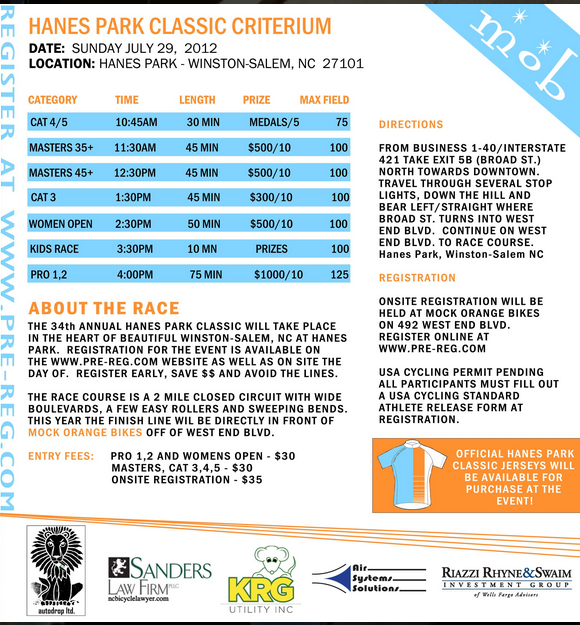
Sanders Law Firm, PLLC is proud to be one of the main sponsors of the Hanes Park Classic 2012. We were a sponsor for the 2011 race too.
Mock Orange Bike puts on the Criterium race in Winston-Salem.
Below is a schedule of the races on Sunday, July 29th. For more information go to: http://www.mockorangebikes.com/about/hanes-park-classic-pg86.htm
Register for the race at www.pre-reg.com
July 27-29th High Point Cycling Challenge & Criterium
The Final State Cycling Championship begins at 8:00pm
Full weekend of activities. For more information go to:
And yes, that is a 4 story dresser in picture below. High Point’s legitimately known as the Furniture Capital of the World!
2011 has seen several fatal cycling accidents in the mountains, including in December, when Lees-McRae freshman cyclist Megan Baab was killed while bicycle training on U.S. 221 in North Carolina. Allegedly another college student driving a pickup truck crossed the center line and collided head on with Ms. Baab. The driver was charged with misdemeanor death by vehicle.
The Lees-McRae Cycling Team suffered yet another tragedy in the beginning of 2011, when senior rider Carla Swart died after she was struck by a truck while training in her native South Africa.
In July, Winston-Salem doctor Erik Lie-Nielsen, 35, died after reportedly losing control of his bicycle and crashing into an oncoming vehicle during the Grizzly Bike Ride, a Grandfather Mountain Highland Games event. The driver in this death was not deemed to be at fault.
Avid cyclists attribute the deaths in the mountains not to the hilly & curvy terrain but more to increased traffic in the region.
To increase safety of pedestrians & bikers, please see the program started by Boone Area Cyclists, a local club, called theHigh Country Safe Streets Pledge. Those signing the pledge vow to follow
1) the “Golden Rule”— pedestrians first, bicyclists second and motorists third.
2) Cyclists pledge to wear a helmet for every ride, and
3) motorists pledge to be patient and respectful while passing cyclists, giving them at least three feet of space.
To sign the pledge, visit http://www.booneareacyclists.com -streets-pledge.
Sanders Law Firm, PLLC supports bicyclists and motorcyclists share the road. Call (336) 724-4707 to speak with Kirk Sanders about your bike legal issues